
Recent Articles

Filed an Extension but Can’t Pay?
Quick Answer: File your return by October 15, 2026, even if you can't pay. An extension only gave you more time to file, not to pay, so interest at 7% and a 0.5% monthly late-payment penalty have run since April 15. Missing October 15 adds a failure-to-file penalty of...

A CSED-First Framework for 2026
Quick Answer: The right IRS resolution strategy depends less on your balance and more on your Collection Statute Expiration Date (CSED) — generally 10 years from assessment under IRC §6502. A debt near expiration is often handled differently than one from last year,...
The IRS Collection Tools Most Taxpayers Don’t See Coming
Quick Answer: Beyond a bank levy, the IRS has tools many taxpayers don't expect: a federal tax lien attaching to everything you own (IRC §6321), levies reaching retirement accounts and up to 15% of monthly Social Security, and passport certification under IRC §7345...

Comparing Every IRS Resolution Option in 2026
Quick Answer: The IRS offers four paths for a balance you can't pay in full: an Offer in Compromise to settle for less, an Installment Agreement to pay over time, a Partial Pay Installment Agreement for larger balances, and Currently Not Collectible status during...
The Real IRS Collection Timeline in 2026
Quick Answer: IRS collection follows a fixed sequence: a CP14 balance-due notice, escalation through CP504, then LT11 or Letter 1058 — the Final Notice of Intent to Levy. That letter starts a 30-day countdown to request a Collection Due Process hearing under IRC...
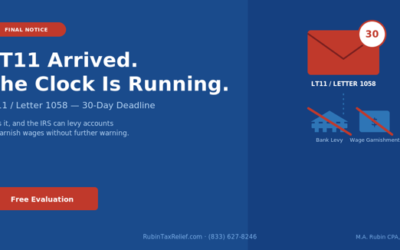
Missed Your LT11 Deadline? What Happens After the IRS’s Final Notice in 2026
Quick Answer: An LT11 or Letter 1058 is the IRS's Final Notice of Intent to Levy. It gives you 30 days to file Form 12153 for a Collection Due Process hearing before the IRS can levy bank accounts or garnish wages. Miss that window, and Commissioner v. Zuch (2025)...