
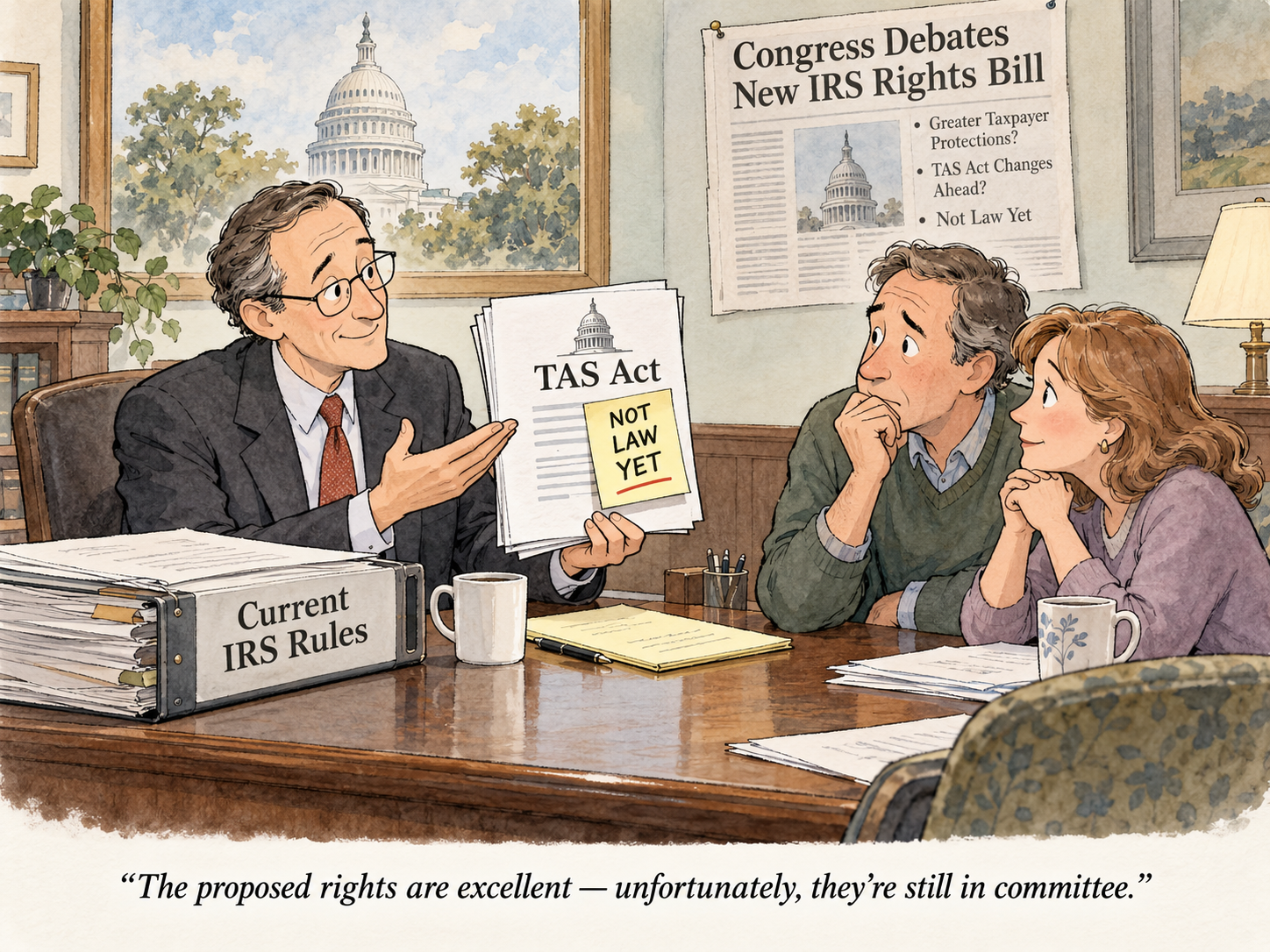
Quick Answer: The Taxpayer Assistance and Service (TAS) Act passed the Senate unanimously on September 30, 2026, but it is not law yet. The House must act next. If enacted, it would waive payment-plan fees for some low-income taxpayers, require the IRS to tell struggling taxpayers about hardship options, and expand appeal rights. Today’s IRS rules still apply.
If you owe the IRS, you may have seen headlines about a new "taxpayer rights" bill and wondered whether help is on the way. Some of it may be. But a bill that passes one chamber of Congress does not change your IRS account. Here is what the Taxpayer Assistance and Service Act would do, what it would not do, and why waiting for it is a mistake.
What Is the Taxpayer Assistance and Service Act?
The TAS Act is a bipartisan package of 65 reforms to IRS customer service, taxpayer rights, the Tax Court, and paid preparer oversight, according to Thomson Reuters. Senate Finance Chair Mike Crapo and Ranking Member Ron Wyden introduced it in February 2026. The committee approved it 26–1 in July, and the full Senate passed it by unanimous consent on September 30, 2026, as a substitute to House bill H.R. 5349.
Is the TAS Act Law Yet in 2026?
No. Because the Senate amended a House bill, the House has to vote on the Senate’s version before it can go to the President. KPMG reported that the House could take it up after returning on November 9, 2026. Even after enactment, many provisions start 12 to 24 months later. Until then, current IRS collection rules, deadlines, and fees stay exactly as they are.
What Would Change for Payment Plans and Hardship?
The bill would waive payment-plan setup fees for lower-income individuals; Thomson Reuters puts the cutoff at 250% of the federal poverty line. It would require the IRS to tell taxpayers who appear to be in financial hardship about alternatives like a Partial Pay Installment Agreement (PPIA), an Offer in Compromise (OIC), or Currently Not Collectible (CNC) status. Accounts in CNC status would also get automatic protection of the Earned Income Tax Credit (EITC) portion of refunds from offset.
What Would Change for Offers in Compromise and Levies?
The Senate Finance Committee’s summary describes several fixes. The IRS would have to release levies when it accepts an offer and return money it collects beyond the accepted amount. Taxpayers could appeal an offer the IRS returns as "non-processable," which they can’t do today. Anyone paid to prepare an offer would have to put an identifying number on it, a step aimed at OIC mills, with a $250 penalty per offer for skipping it.
What Would Change for Appeals and Tax Court?
The bill would let the Tax Court decide the underlying tax and order refunds in more Collection Due Process (CDP) cases under IRC §6330. It would confirm that courts can extend missed CDP, deficiency, and innocent spouse (IRC §6015) petition deadlines in fair circumstances, building on Boechler v. Commissioner (2022). It would double the small tax case limit from $50,000 to $100,000 and require written supervisor approval before penalties are assessed.
TAS Act Changes at a Glance
|
Problem today |
What the TAS Act would do |
When it would start |
|
Payment-plan setup fees |
Waive fees for lower-income individuals |
Plans made 12+ months after enactment |
|
Hardship taxpayers in plans they can’t afford |
IRS must flag PPIA, OIC, and CNC options |
Within 12 months of enactment |
|
"Non-processable" offers can’t be appealed |
Appeal to the IRS Independent Office of Appeals |
On enactment |
|
Levies continue after an offer is accepted |
IRS must release levies and refund excess |
Offers accepted after enactment |
|
Missed CDP petition deadline |
Tax Court can extend it when fair |
Cases pending on or after enactment |
|
Annual notices only on old balances |
Quarterly notices showing interest and penalties |
24 months after enactment |
What the TAS Act Would Not Do
It would not reduce any tax you owe, erase penalties already assessed, stop interest, or shorten the 10-year Collection Statute Expiration Date (CSED) under IRC §6502. It would not pause collection while Congress debates it. Some provisions, such as new paid-preparer standards and a felony for "ghost" preparers who refuse to sign returns, protect future filers more than people with existing balances.
A Situation We See Often
Illustrative example based on common case patterns; details are changed and combined. A taxpayer on a fixed income read that Congress was "making IRS payment plans free" and stopped sending his $250 monthly installment payment to wait for the new rules. Within a few months, his plan was at risk of default and the IRS could resume levy action. We got his payments current and showed his income likely qualified him for CNC status under existing rules — no new law required.
Frequently Asked Questions
Q: Did Congress pass a new law to help people who owe the IRS?
A: Not yet. The Taxpayer Assistance and Service Act passed the Senate on September 30, 2026. The House must approve the Senate’s version, and the President must sign it, before it becomes law.
Q: Will the TAS Act make IRS payment plans free?
A: For some people. The Senate-passed bill would waive installment agreement fees for lower-income individuals, reported as those up to 250% of the federal poverty line, for plans made more than 12 months after it becomes law. Current IRS fees still apply today.
Q: Should I wait for the TAS Act before dealing with my IRS debt?
A: No. Interest at 7% and penalties keep growing, and collection notices keep going out. Most relief in the bill starts 12 to 24 months after enactment, and options like CNC status and payment plans are available now.
Q: Does the TAS Act do anything about OIC mills?
A: Yes, indirectly. Anyone paid to prepare an Offer in Compromise would have to include an identifying number on it, with a $250 penalty per offer for failing to do so, up to $75,000. Taxpayers could also appeal offers returned as "non-processable."
Q: Would the TAS Act help if I missed my Collection Due Process deadline?
A: Possibly. It would confirm that the Tax Court can extend CDP petition deadlines when it is fair to do so. That builds on the Supreme Court’s 2022 Boechler decision, which already allows this for CDP petitions.
Disclaimer: This blog post is for informational purposes only and does not constitute legal or tax advice. Consult with a qualified tax professional for advice specific to your situation.
The TAS Act may improve the system someday, but it won’t stop interest on your balance this month or pause the notices already in the mail. M.A. Rubin CPA, PLLC, based in Tampa and serving taxpayers nationwide, uses the hardship options and payment plans available today and will track the bill as it moves. Call (833) 627-8246 or visit RubinTaxRelief.com for a free case evaluation instead of waiting on Congress.
Sources: Senate Finance Committee — Taxpayer Assistance and Service Act section-by-section summary (https://www.finance.senate.gov/imo/media/doc/taxpayer_assistance_and_service_act_sbs.pdf); Thomson Reuters — "Senate passes broad tax administration reform legislation," Oct. 2, 2026 (https://tax.thomsonreuters.com/news/senate-passes-broad-tax-administration-reform-legislation/); KPMG TaxNewsFlash — "Senate passes bipartisan tax administration reform package," Oct. 1, 2026 (https://kpmg.com/us/en/taxnewsflash/news/2026/10/senate-passes-tax-administration-reform-package.html); IRS.gov — Payment plans; installment agreements (https://www.irs.gov/payments/payment-plans-installment-agreements).
