By M. Rubin, CPA — M.A. Rubin CPA PLLC / RubinOrtolano | Published: July 19, 2026 | Reviewed by: D. Ortolano Jr. EA, former IRS Revenue Officer & Revenue Agent RubinOrtolano
- Passive activity losses generally offset only passive income; misclassifying an activity can suspend losses indefinitely under IRC §469.
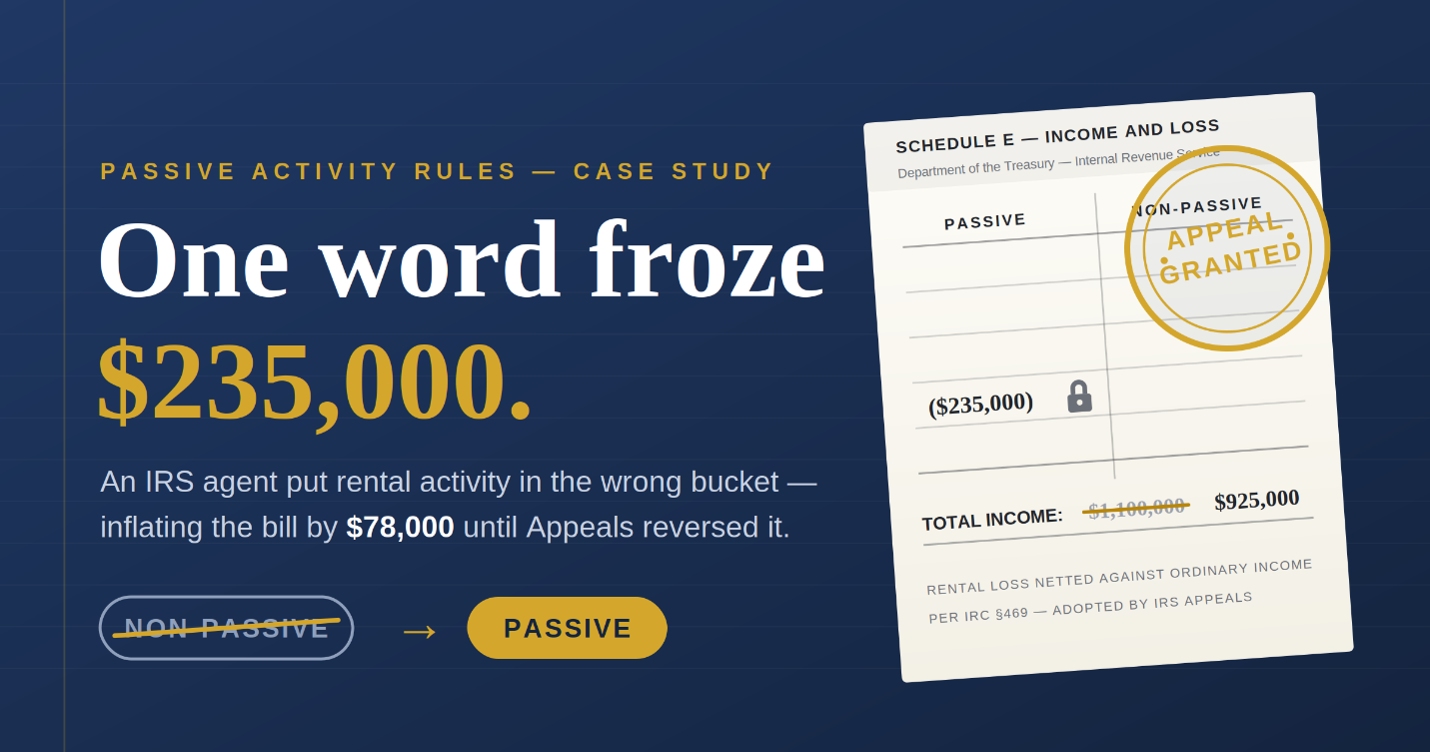
- In one Rubin CPA case, a Revenue Agent’s reclassification stranded $235,000 in rental losses — inflating the client’s audit bill by $78,000 until reversed on appeal.
- A spouse who doesn’t work in the business can still be credited with the active spouse’s participation — classifying a non-participating spouse as passive on everything is a common preparer error that invites audit scrutiny.
- Classification errors are among the most reversible audit adjustments — if challenged before appeal rights expire.
One word on a tax return — “passive” — froze $235,000 of a client’s losses and inflated his IRS audit bill by $78,000.
The word was wrong. Proving that took an appeal, a set of workpapers, and a written explanation the IRS Appeals Officer ultimately adopted into her own report. Here’s how passive activity classification works, how audits get it wrong, and how to unwind the damage.
What is the difference between passive and non-passive income?
Non-passive income comes from activities in which you materially participate — regular, continuous, substantial involvement. Passive income comes from activities you don’t materially participate in, and, with limited exceptions, from rental activities. The distinction controls what your losses can do: under Internal Revenue Code §469, passive losses generally offset only passive income. Losses that can’t be used are suspended — parked, sometimes for years, until there’s passive income to absorb them or the activity is disposed of.
Why does misclassification freeze losses?
Because classification determines which bucket income and losses land in — and the buckets don’t mix. In the Rubin CPA case above, a married couple held interests in five flow-through entities, including a property management partnership that owned the land and buildings used by their operating companies. The examining agent reclassified the partnership’s ordinary income and rental losses inconsistently across the two spouses. The result: $500,000 of income taxed in full while the related $235,000 rental loss sat suspended — unable to offset the very income it belonged with. Properly classified, the activity was rental across the board, the amounts netted, and the client’s income fell from roughly $1.1 million to $925,000.
How is a spouse’s participation treated?
A spouse’s material participation is attributed between spouses — a spouse who never sets foot in the business can be treated as materially participating if the other spouse does. That’s why classifying a non-participating spouse as “passive on everything” is both wrong and dangerous: the inconsistency between two spouses’ returns for the same activities is exactly the kind of anomaly that draws examination. In our case, the original preparer had done precisely that — and we believe it’s what put the passive/non-passive question at the center of the audit.
How do audits get classification wrong?
Three ways, in our experience. First, agents inherit the preparer’s inconsistencies and “split the difference” rather than analyzing the underlying activity. Second, reassigned-audit errors: when an exam changes Revenue Agents — this one changed three times, and the last agent left the IRS mid-case — classification analysis rarely gets re-performed. Third, audit software doesn’t think. The IRS’s Report Generation Software calculates the adjustments it’s told to make; it flags nothing about whether an activity was genuinely a rental, and it won’t even automatically add computational items like the Qualified Business Income Deduction.
How do you challenge a passive activity misclassification?
Document the activity itself — what the entity actually does, who does it, and how time is spent — then trace each income and loss item to the correct bucket for each spouse. On appeal, present the workpapers the way the IRS builds them: our written explanation was drafted in the format of a Revenue Agent’s closing lead sheet, which the Appeals Officer could carry directly into her manager-approved write-up. She agreed to the full reclassification. The bill fell from $411,000 to $333,000.
FAQ
Q: What are suspended passive losses?
A: Passive losses that exceed passive income in a year are suspended and carried forward under IRC §469 — usable against future passive income or generally freed upon a fully taxable disposition of the activity.
Q: Can rental income ever be non-passive?
A: In limited situations — real estate professional status, certain self-rental rules, and short-term rental fact patterns among them. Classification is fact-intensive; assumptions in either direction are where audits and preparers go wrong.
Q: Can a classification error be fixed after an audit closes?
A: Often, if appeal rights on an affected return are still open. One Rubin CPA client reversed a misclassification on appeal after the underlying business audit was already signed. Deadlines are strict — act immediately. (See our guide: Can You Appeal an IRS Audit After You’ve Already Signed?)
If an audit — or your own return — labeled activities passive or non-passive without analysis, the label is worth checking. Request a confidential review from Rubin CPA. Results depend on the facts of each case; past results do not guarantee a similar outcome.
M.A. Rubin CPA, PLLC – RubinOrtolano – A Tax Resolution & Representation Firm
Tel: 833 MA Rubin (627 8246)
Email: Blog@RubinTaxRelief.com
Disclaimer: This blog post is for informational purposes only and does not constitute legal or tax advice. Consult a qualified professional for specific advice regarding your situation.
Disclaimer: This blog post is for informational purposes only and does not constitute legal or tax advice. Consult with a qualified professional for specific advice regarding your business.
