
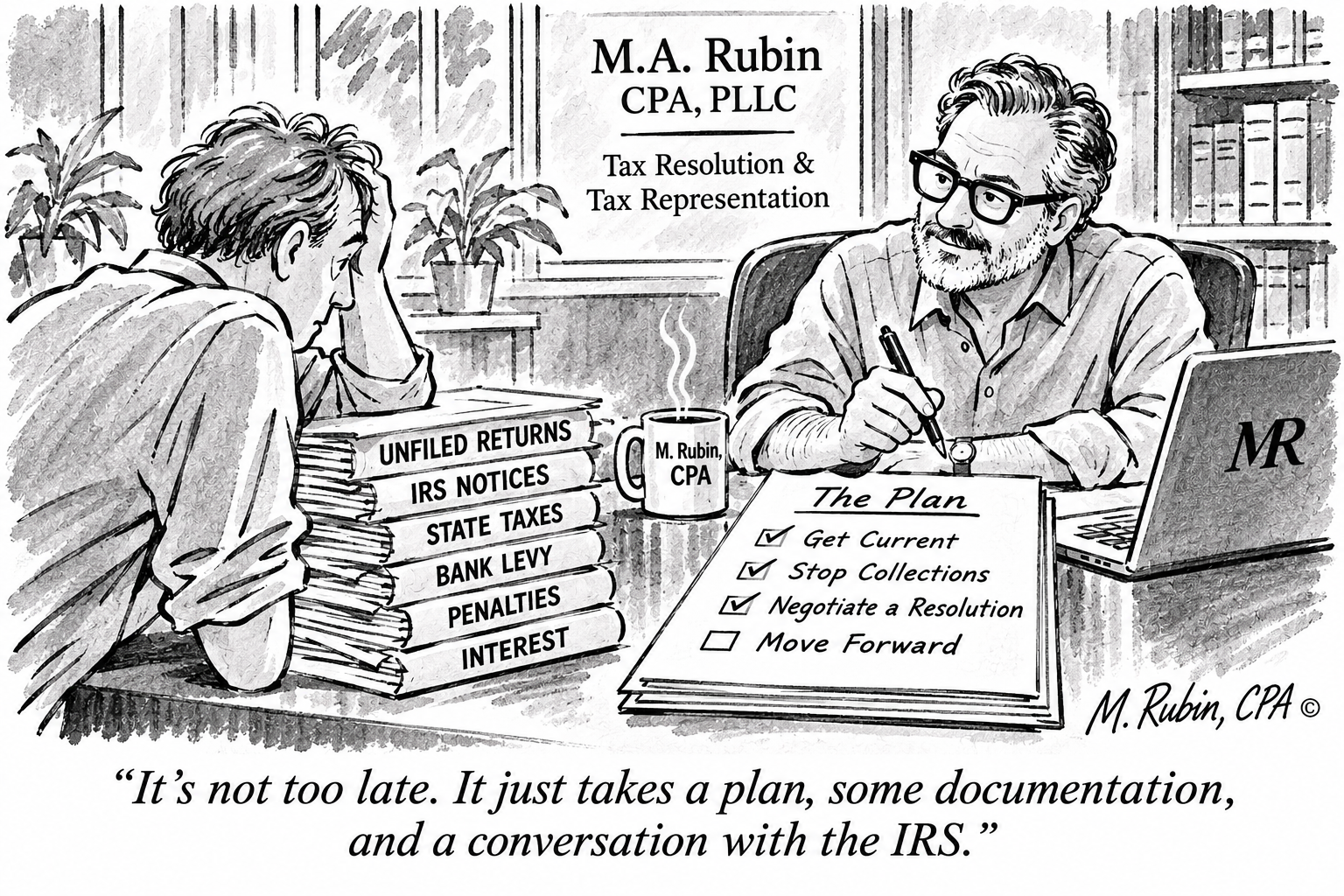
Quick Answer: If you owe the IRS, use the last weeks of 2026 to check your IRS Online Account balance, file any missing returns, set up or fix a payment plan, and make sure your 2026 estimated payments or withholding are on track. The fourth-quarter estimated payment is due January 15, 2027. Interest is currently 7% a year.
The end of the year is when people who owe the IRS tend to put it off one more time. The holidays are expensive, and an IRS balance doesn’t feel urgent next to everything else. But a few steps before December 31 and January 15 can stop a new balance from stacking on top of the old one. Here is a year-end checklist for anyone who owes the IRS.
Step 1: Find Out Exactly What You Owe
Start with your IRS Individual Online Account at IRS.gov or in the new IRS mobile app the agency launched this fall. It shows your balance by year, payments, active payment plans, and some notices. The IRS said 37.6 million people used Online Account in fiscal year 2026, up 34%. Your account transcript also shows each year’s Collection Statute Expiration Date (CSED) clock, which generally runs 10 years from assessment under IRC §6502.
Step 2: File Any Missing Tax Returns
Unfiled returns are the biggest barrier to every IRS relief option. The IRS generally won’t approve an Offer in Compromise (OIC), most payment plans, or Currently Not Collectible (CNC) status until you’re current on filing. The failure-to-file penalty is 5% of the unpaid tax per month, up to 25%, which is 10 times the monthly failure-to-pay penalty. If you can’t pay, filing still stops the larger penalty.
Step 3: Get Your Payment Plan Right
If you have a balance and no plan, a payment plan stops most collection action and cuts the failure-to-pay penalty from 0.5% to 0.25% per month while the plan is in effect, as long as your return was filed on time. Individuals who owe $50,000 or less in combined tax, penalties, and interest can usually apply online. If your current plan’s payment no longer fits your budget, ask to change it before you miss a payment.
Step 4: Don’t Create a New Balance for 2026
This is where many people get stuck: they pay down old years while a new balance grows for the current one. Use the IRS Tax Withholding Estimator to check your paycheck withholding, and submit a new Form W-4 if needed. If you’re self-employed, the fourth-quarter 2026 estimated payment is due January 15, 2027. Staying current is also a condition of keeping most IRS payment plans.
Step 5: Check for Penalty Relief Before You Pay Penalties
If this is your first penalty in a while, First-Time Abate (FTA) may remove failure-to-file, failure-to-pay, and failure-to-deposit penalties for one tax year if you had no significant penalties in the prior three years. Interest on removed penalties comes off too. Reasonable-cause relief covers events like serious illness or a disaster. Ask before paying penalties, because getting a refund later takes longer.
Year-End Moves Compared
|
Action |
Deadline |
What it protects you from |
|
Review Online Account balance |
Anytime; do it in November |
Surprise notices and wrong balances |
|
File missing returns |
ASAP |
5% per month failure-to-file penalty |
|
Set up or revise a payment plan |
Before the next missed payment |
Levy action; higher 0.5% monthly penalty |
|
Adjust Form W-4 withholding |
December payroll |
A new 2026 balance due in April |
|
Make Q4 estimated payment |
January 15, 2027 |
Estimated tax penalty and plan default |
|
Request FTA or reasonable cause |
Before paying penalties |
Paying penalties you may not owe |
What About the 2027 Tax Brackets?
As of October 31, 2026, the IRS had not yet released its tax year 2027 inflation adjustments; it typically does so in October or November in an annual Revenue Procedure. The IRS also announces the first-quarter 2027 interest rate in November. Neither changes what you owe today, but both affect next year’s planning, so check IRS.gov before setting 2027 withholding or estimated payments.
If You’re in a Hurricane Isaias Disaster County
Taxpayers in the 27 Florida counties covered by IRS relief FL-2026-07 have until February 8, 2027, to make the January 15 estimated payment without an estimated tax penalty. That relief does not pause older balances or interest. See our November post on Hurricane Isaias relief for the full list of what it covers.
A Situation We See Every January
Illustrative example based on common case patterns; details are changed and combined. A self-employed contractor paid $600 a month on an IRS plan for 2023 taxes but skipped 2025 estimated payments to keep up. In April, a new $11,000 balance landed on top of the old one, and the plan was at risk. We rolled both years into one revised agreement and set up quarterly estimates so it wouldn’t happen again.
Frequently Asked Questions
Q: Should I pay the IRS before the end of the year?
A: If you can, paying sooner reduces interest, which is currently 7% a year and compounds daily. But don’t drain your emergency fund. A payment plan plus current-year estimated payments is often a better use of cash than one lump sum.
Q: When is the last estimated tax payment for 2026 due?
A: The fourth-quarter 2026 estimated payment is due January 15, 2027. Taxpayers in the Florida counties covered by Hurricane Isaias relief have until February 8, 2027.
Q: Can the IRS take my tax refund if I owe back taxes?
A: Yes. The IRS generally applies your refund to past-due federal tax debt. If that offset would cause an economic hardship, you may be able to request an offset bypass refund, but you must ask quickly after filing.
Q: What happens if I miss a payment on my IRS installment agreement?
A: A missed payment can put your plan in default, and the IRS can resume collection, including levies. Call the IRS or a tax professional before the payment date to change the plan.
Q: Will the IRS forgive penalties if I ask?
A: Sometimes. First-Time Abate removes certain penalties for one tax year if your prior three years are clean. Reasonable-cause relief covers events like serious illness or disasters. Interest itself generally cannot be forgiven.
Disclaimer: This blog post is for informational purposes only and does not constitute legal or tax advice. Consult with a qualified tax professional for advice specific to your situation.
Every month you wait adds 7% annual interest and up to 0.5% in penalties to what you owe, and a missed January 15 estimate can stack a new balance on the old one. M.A. Rubin CPA, PLLC, based in Tampa and serving taxpayers nationwide, can pull your transcripts, check for penalty relief, and set up a plan that covers both old and new years. Call (833) 627-8246 or visit RubinTaxRelief.com for a free case evaluation before the year ends.
Sources: IRS.gov — IRS reminder: Year-round tax planning can make filing easier (IR-2026-128, Oct. 23, 2026) (https://www.irs.gov/newsroom/irs-reminder-year-round-tax-planning-can-make-filing-easier); IRS.gov — IRS achieved historic performance in 2026 (IR-2026-129, Oct. 29, 2026) (https://www.irs.gov/newsroom/irs-achieved-historic-performance-in-2026-for-american-taxpayers-efficiently-delivering-new-tax-benefits-to-working-families); IRS.gov — Payment plans; installment agreements (https://www.irs.gov/payments/payment-plans-installment-agreements); IRS.gov — Penalty relief (https://www.irs.gov/payments/penalty-relief).
