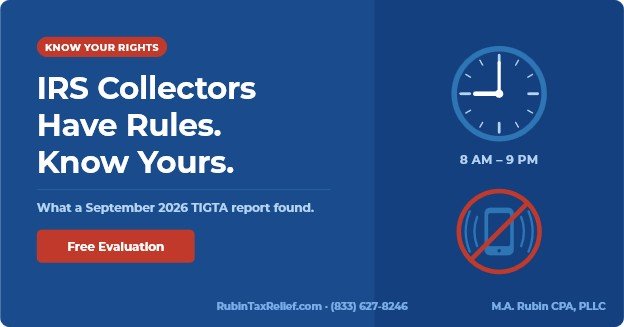
Quick Answer: Under IRC §6304, IRS collectors generally cannot contact you before 8 a.m. or after 9 p.m., at work if your employer forbids it, or directly if you have an authorized representative. They cannot harass or abuse you. A September 2026 Treasury watchdog report found the most common violation was bypassing a taxpayer’s representative.
When you owe the IRS, every phone call and letter can feel like a threat. Many people don’t know that IRS employees and the private agencies that collect for the IRS have to follow specific rules about how they contact you. A new report from the Treasury Inspector General for Tax Administration (TIGTA), released September 23, 2026, shows those rules are sometimes broken. Here are your IRS collection rights, in plain English.
What Are My Rights When the IRS Collects a Tax Debt?
Your main collection protections come from IRC §6304, called the Fair Tax Collection Practices (FTCP). Congress added them in the IRS Restructuring and Reform Act of 1998 so the IRS would treat taxpayers at least as fairly as private debt collectors must. You also have the Taxpayer Bill of Rights, which includes the right to retain representation and the right to challenge the IRS’s position and be heard.
What Can’t IRS Collectors Do Under IRC §6304?
Without your consent or a court order, IRS collection employees may not contact you at an unusual or inconvenient time or place. Unless they know otherwise, the law assumes before 8 a.m. or after 9 p.m. is inconvenient. They also may not contact you at work if they know your employer prohibits it, or contact you directly if they know you have an authorized representative who is responding.
What Counts as Harassment or Abuse by the IRS?
IRC §6304(b) bans any conduct whose natural result is to harass, oppress, or abuse you while collecting a tax. The law lists specific examples: threatening violence or harm to your person, reputation, or property; using obscene or profane language; calling repeatedly to annoy or harass; and placing calls without meaningfully identifying who is calling.
What Did the September 2026 TIGTA Report Find?
TIGTA report 2026-300-057 reviewed IRS cases from July 1, 2024, through June 30, 2025. It identified 32 potential FTCP violations in the IRS’s misconduct tracking system, mostly employees bypassing a taxpayer’s authorized representative. TIGTA also found 735 more potential violations flagged by IRS managers in quality reviews that were never reported as required. The IRS partially agreed with all three of TIGTA’s recommendations.
Who Are the IRS Private Debt Collectors?
The law requires the IRS to assign certain inactive tax debts to private collection agencies (PCAs). Since September 23, 2021, the three agencies have been CBE Group, Coast Professional, and ConServe, according to IRS.gov. Before a PCA contacts you, the IRS sends Notice CP40, and the agency then sends its own letter. Both letters include a taxpayer authentication number you can use to confirm the caller is real.
What Did TIGTA Find About Private Collectors?
The same TIGTA report identified 56 potential violations by PCA employees: 51 under the Fair Debt Collection Practices Act (FDCPA) and 5 under the FTCP. Of the FDCPA issues, 28 involved failing to send timely debt validation, and 18 involved sharing sensitive taxpayer information, such as the existence of a debt, with an unauthorized third party. TIGTA said disciplinary action matched each agency’s policies.
IRS Employees vs. Private Collection Agencies: Who Follows Which Rules?
|
Question |
IRS Collection Employees |
Private Collection Agencies (PCAs) |
|
Main law |
IRC §6304 (Fair Tax Collection Practices) |
FDCPA, plus the same FTCP limits through their IRS contracts (IRC §6306) |
|
Can they call before 8 a.m. or after 9 p.m.? |
Not without consent |
Not without consent |
|
Must they go through your representative? |
Yes, if they know you’re represented and the representative responds |
Yes |
|
How you know they’re legitimate |
IRS notice with your notice number; verify on your IRS online account |
IRS Notice CP40 first, then the PCA’s letter, both with a taxpayer authentication number |
|
Where to report misconduct |
TIGTA hotline |
TIGTA hotline |
|
Who you can sue |
The U.S. government, under IRC §7433, in certain cases |
The private agency, not the government |
Why Having a Representative Changes How the IRS Contacts You
Filing Form 2848, Power of Attorney and Declaration of Representative, generally means the IRS must deal with your CPA, attorney, or Enrolled Agent instead of you. TIGTA found that bypassing representatives was the most common problem — including when represented taxpayers called the IRS themselves and employees didn’t ask for consent to continue without the representative. If you have a representative and the IRS contacts you directly, you can ask them to contact your representative.
What Should I Do If a Collector Breaks the Rules?
Write down the date, time, caller’s name, and what was said. You can report IRS or PCA employee misconduct to the TIGTA hotline, and the Taxpayer Advocate Service can help if your case is stuck. Under IRC §7433, a taxpayer may sue the government for damages if an IRS employee recklessly, intentionally, or negligently disregards the tax code in collection. TIGTA reported no monetary awards in the period it reviewed.
A Situation We See Often
Illustrative example based on common case patterns; details are changed and combined. A client who had signed a Form 2848 with us called the IRS automated collection line herself to “just check a balance.” The employee walked her through payment terms without asking whether she wanted to continue without her representative, and she agreed to a monthly amount she couldn’t afford. We contacted the IRS, revised the agreement to match her actual budget, and documented the contact.
Frequently Asked Questions
Q: Can the IRS call me at work about my tax debt?
A: Not if the IRS knows or has reason to know your employer prohibits those calls. Tell the collector your employer doesn’t allow them, and keep a note of when you said it.
Q: Is a private debt collector calling about my IRS debt legitimate?
A: It can be. The IRS uses three agencies: CBE Group, Coast Professional, and ConServe. You should receive IRS Notice CP40 first, and both letters include a taxpayer authentication number you can use to confirm the caller.
Q: Does the IRS have to talk to my tax professional instead of me?
A: Generally, yes. If you’ve filed Form 2848 and the IRS knows your representative’s name and address, IRC §6304 bars direct collection contact with you unless your representative doesn’t respond in a reasonable time or consents.
Q: What should I do if an IRS collector is harassing me?
A: Document every contact and report it to the Treasury Inspector General for Tax Administration hotline. You can also contact the Taxpayer Advocate Service or hire a representative so future contacts go through them.
Q: Can I sue the IRS for unfair collection practices?
A: In limited cases. IRC §7433 lets a taxpayer seek damages if an IRS employee recklessly, intentionally, or negligently disregards the tax code while collecting. Claims against a private collection agency are brought against the agency, not the government.
Knowing your rights matters most before you agree to anything on a collection call — a payment amount you can’t keep can push your case toward default and a levy. M.A. Rubin CPA, PLLC represents taxpayers nationwide from Tampa, and once we file Form 2848, collection contact generally comes through us. Call (833) 627-8246 or visit RubinTaxRelief.com for a free case evaluation before your next collection call.
Disclaimer: This blog post is for informational purposes only and does not constitute legal or tax advice. Consult with a qualified professional for specific advice regarding your business.
Sources: TIGTA Report No. 2026-300-057, Fiscal Year 2026 Statutory Review of Potential Fair Tax Collection Practices Violations, September 23, 2026; IRS.gov — Private Debt Collection; IRS.gov — Taxpayer Bill of Rights; IRS.gov — About Form 2848.
