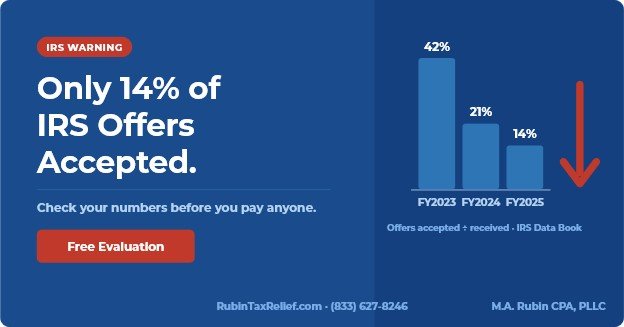
Quick Answer: The IRS accepted 5,464 of 38,797 Offers in Compromise in fiscal year 2025, about 14%, according to the IRS Data Book. That is down from about 21% in 2024 and about 42% in 2023. An offer works only if it matches what the IRS calculates it could collect from your income and assets.
If you’ve seen ads promising to settle your IRS debt for “pennies on the dollar,” you’ve probably wondered whether it could work for you. The honest answer in 2026 is: maybe, but far less often than those ads suggest. The IRS Offer in Compromise (OIC) acceptance rate dropped sharply over the last two years, and the IRS itself put misleading OIC marketing on its 2026 “Dirty Dozen” list of tax scams. Here is what the numbers say and how to protect yourself.
What Is the IRS Offer in Compromise Acceptance Rate in 2026?
The most recent full-year figure is about 14%. The IRS Data Book (Table 4-1) shows the IRS received 38,797 offers in fiscal year 2025 and accepted 5,464. In fiscal year 2024, it received 33,591 and accepted 7,199. In fiscal year 2023, it received 30,163 and accepted 12,711. Offers received rose while acceptances fell by more than half.
Offers Received vs. Offers Accepted, FY2023–FY2025
| IRS Fiscal Year | Offers Received | Offers Accepted | Accepted ÷ Received |
| 2023 | 30,163 | 12,711 | ~42% |
| 2024 | 33,591 | 7,199 | ~21% |
| 2025 | 38,797 | 5,464 | ~14% |
Source: IRS Data Book, Table 4-1 (FY2024 and FY2025 editions). Offers accepted in a year are not always the same offers received that year, so this ratio is a trend, not your personal odds.
Why Did OIC Acceptances Drop So Much?
The IRS has not given a single official reason. CNBC reported in September 2026 that accepted offers fell about 57% from 2023 to 2025, and that the total dollar value of accepted offers fell from $214.5 million to $98.1 million. Former National Taxpayer Advocate Nina Olson told CNBC, “I’ve never seen a number that low.” The IRS told CNBC its acceptance rate for decided cases stayed stable in fiscal 2026.
How Does the IRS Decide Whether to Accept an Offer?
The IRS accepts an offer when it equals what the agency believes it could reasonably collect from you, a figure called Reasonable Collection Potential (RCP). RCP is built from the equity in your assets plus your future disposable income. The IRS evaluates this using Form 433-A (OIC) for individuals or Form 433-B (OIC) for businesses. The size of your debt is not the deciding factor — your ability to pay is.
What Does It Cost to File an Offer in Compromise?
Filing an offer costs money up front, even if it’s rejected. According to IRS.gov, Form 656 requires a $205 non-refundable application fee. A lump-sum offer also requires a non-refundable payment of 20% of the offer amount. A periodic-payment offer requires monthly payments while the IRS reviews it. Taxpayers who meet the low-income certification guidelines do not have to pay the fee or the initial payments.
What Happens to My Account While an Offer Is Under Review?
An offer changes your account in ways many people don’t expect. While the IRS reviews it, other collection is generally suspended, but the IRS may file a Notice of Federal Tax Lien, and your 10-year Collection Statute Expiration Date (CSED) is extended. If the IRS makes no decision within two years of receiving it, the offer is treated as accepted. A rejection can be appealed within 30 days on Form 13711.
How to Spot an OIC Mill
The IRS named “aggressive or misleading Offer in Compromise marketing” on its 2026 Dirty Dozen list. These “OIC mills” charge high fees and promise settlements to people who don’t qualify. Warning signs include a quoted settlement amount before anyone reviews your income, expenses, and assets; large fees before any work begins; and a sales script that skips the other IRS programs that might fit better.
| Ethical Tax Professional | OIC Mill |
| Reviews your income, expenses, and asset equity before recommending anything | Quotes a settlement percentage on the first call |
| Compares an OIC with payment plans, Currently Not Collectible (CNC) status, and penalty relief | Pushes an OIC for nearly every caller |
| Explains the $205 fee, the 20% lump-sum payment, and the CSED extension | Leaves out non-refundable costs and side effects |
| Tells you when your numbers don’t support an offer | Files offers that are likely to be returned or rejected |
| Is a CPA, attorney, or Enrolled Agent authorized to represent you on Form 2848 | Uses unlicensed salespeople |
What Should I Do Instead If an Offer Won’t Work?
Most taxpayers who don’t qualify for an offer still have real options. These include a Simple Payment Plan for most individuals who owe $50,000 or less, a long-term installment agreement (Form 9465), a Partial Pay Installment Agreement (PPIA) for balances that can’t be paid in full before the CSED, CNC status during genuine hardship, and First-Time Abate (FTA) penalty relief for people with three clean prior years.
A Situation We See Often
Illustrative example based on common case patterns; details are changed and combined. A taxpayer owing about $60,000 called us after a radio ad told him he could “settle for a fraction.” His home equity and monthly income meant his RCP was well above what an offer would need, so an OIC was likely to be rejected after months of review and a non-refundable $205 fee plus a 20% payment. A properly documented installment agreement, combined with an FTA request on his penalties, fit his numbers better.
Frequently Asked Questions
Q: Can I really settle my IRS debt for less than I owe?
A: Sometimes, through an Offer in Compromise, but the IRS accepted only about 14% of offers relative to offers received in fiscal year 2025. Your offer must match what the IRS calculates it could collect from your assets and future income. A review of your actual numbers before filing tells you whether an offer is realistic.
Q: How much does it cost to apply for an Offer in Compromise?
A: The IRS charges a $205 non-refundable application fee. A lump-sum offer also requires a non-refundable payment of 20% of the offer amount with the application. Low-income taxpayers who meet IRS guidelines can skip the fee and initial payment.
Q: What is an OIC mill?
A: An OIC mill is a company that aggressively markets IRS debt settlement, often promising “pennies on the dollar” and charging high fees to people who don’t qualify. The IRS listed this practice on its 2026 Dirty Dozen list of tax scams.
Q: Does filing an Offer in Compromise stop IRS collection?
A: Generally, yes, while the offer is being reviewed, but the IRS may still file a federal tax lien. Your collection statute is also extended during the review, which gives the IRS more time to collect if the offer is rejected.
Q: What happens if the IRS rejects my offer?
A: You can appeal the rejection within 30 days using Form 13711. Payments and fees you sent with the offer are not refunded; they are applied to your tax balance.
With Offer in Compromise acceptances near 14%, filing the wrong offer can cost you a non-refundable fee, a 20% payment, and months of extra time on your collection clock — while interest keeps running at 7%. M.A. Rubin CPA, PLLC, based in Tampa and serving taxpayers nationwide, reviews your real numbers first and tells you honestly whether an offer fits. Call (833) 627-8246 or visit RubinTaxRelief.com for a free case evaluation before you pay anyone to file.
Disclaimer: This blog post is for informational purposes only and does not constitute legal or tax advice. Consult with a qualified professional for specific advice regarding your business.
Sources: IRS.gov — Offer in Compromise; IRS.gov — Collections, Activities, Penalties and Appeals (IRS Data Book Table 4-1); IRS.gov — Simple Payment Plans; CNBC, “IRS offers in compromise have plummeted,” September 18, 2026.
