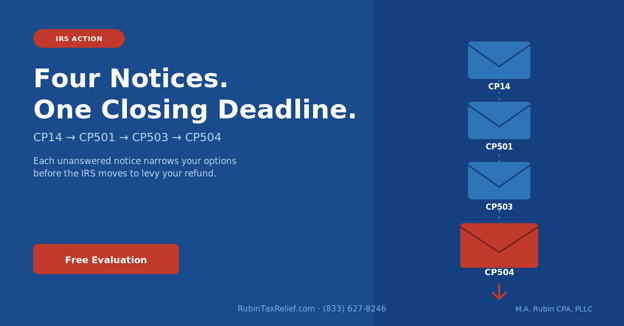
Quick Answer: In 2026 the IRS resumed automated collection notices at full speed, sending CP14, CP501, CP503, and CP504 letters on a fixed schedule again. Each notice narrows your options and shortens your response window. By the time a CP504 arrives, your state tax refund is already at risk and the account is one step from a final levy notice.
If you opened an IRS envelope this month and felt your stomach drop, you’re not imagining things. The agency’s automated notice system, which had been running at a slower, more forgiving pace, is back to full speed — and taxpayers who haven’t heard from the IRS in months are suddenly getting letters again.
This isn’t limited to people who’ve never dealt with the IRS before. We’re hearing from taxpayers who set up a plan years ago, missed a single payment, and are now watching the notice sequence restart as if the account were brand new. Understanding where you are in that sequence, and how much runway each letter actually gives you, is the difference between resolving a balance calmly and reacting to a levy after the fact.
Why Are IRS Notices Suddenly Increasing in 2026?
The IRS released an updated collection-process guide on July 1, 2026, confirming that automated balance-due notices — paused or slowed in recent years — are running again at full volume. Practitioners nationwide report more clients receiving CP14, CP504, and LT11 letters than at any point since before the pandemic.
This isn’t random. As audit staffing has dropped, the IRS has shifted enforcement toward collection tools that require less manual review: liens, levies, wage garnishments, and passport certification. These tools are largely automated, which is why the notices feel relentless once they start arriving.
What Does a CP14 Notice Mean?
A CP14 is the first notice in the collection sequence. It states the specific amount the IRS believes you owe for a tax year and gives you 21 days to pay in full or set up a resolution. Most taxpayers who resolve their debt at the lowest total cost act at this stage, before penalty and interest keep compounding.
What Do CP501 and CP503 Mean?
CP501 and CP503 are reminder notices, arriving roughly five weeks apart. CP501 restates the balance due and asks for a response within 21 days. CP503 is a stronger follow-up, giving 30 days, and signals that the account is moving closer to enforced collection if it continues to go unanswered.
What Makes CP504 Different From the Earlier Notices?
CP504 is a Notice of Intent to Levy your state tax refund, issued under the IRS’s general levy authority in IRC §6331, and it marks a real shift in the process. Unlike CP501 and CP503, which are reminders, CP504 authorizes the IRS to seize a state refund and signals that the account is now on track toward a bank or wage levy if it isn’t addressed within 30 days.
Comparison: IRS Notices CP14 Through CP504
|
Notice |
What It Means |
Response Deadline |
What Happens If Ignored |
|
CP14 |
First balance-due notice |
21 days |
Moves to CP501 reminder |
|
CP501 |
First reminder |
21 days |
Moves to CP503 |
|
CP503 |
Urgent second reminder |
30 days |
Moves to CP504 |
|
CP504 |
Intent to levy state refund |
30 days |
State refund seized; account moves toward LT11 |
What Should I Do When One of These Notices Arrives?
Read the notice in full before deciding it can wait. Each letter states the exact balance, the deadline, and what happens next if you don’t respond. Confirm the amount matches your own records, since IRS notices occasionally reflect a return that was filed incorrectly or a payment that hasn’t posted yet.
If the balance is accurate and you can’t pay it in full, you still have options at every stage in this sequence: a short-term payment plan, an Installment Agreement (Form 9465), an Offer in Compromise (OIC), or Currently Not Collectible (CNC) status if you can’t pay anything right now. If you’ve had three clean compliance years, penalty relief through First-Time Abatement (FTA) may also apply. What you should not do is wait for the next letter to decide — every notice that goes unanswered narrows the list of options available at the next one, and CP504 is the last stop before the Final Notice of Intent to Levy.
Real-World Example
A Tampa small business owner set aside a CP503 in early 2026, assuming it was a duplicate of the CP501 he’d already filed away. Six weeks later, his state tax refund was applied to the balance under a CP504, and a final notice followed shortly after. Responding at the CP14 or CP501 stage would have kept far more options on the table.
Frequently Asked Questions
Q: What’s the very first letter the IRS sends when I owe money?
A: That’s the CP14. It states your balance and gives you 21 days to pay or respond before the account moves into reminder notices and, eventually, levy warnings.
Q: Is a CP501 the same thing as a CP503?
A: No. CP501 is the first reminder; CP503 is a stronger follow-up sent about five weeks later if the CP501 goes unanswered, and it carries a 30-day deadline instead of 21.
Q: Can the IRS really take my state tax refund over a CP504?
A: Yes. CP504 specifically authorizes the IRS to seize a state tax refund, and it signals that the account is heading toward a levy on bank accounts or wages if it isn’t resolved.
Q: Why am I suddenly getting IRS letters after months of silence?
A: The IRS resumed its full automated notice schedule in 2026 after a slower period. Accounts that sat quiet for a while are now moving through the CP14–CP504 sequence at the standard pace again.
Q: What should I do the moment a CP14 or CP501 arrives?
A: Respond before the deadline on the letter, even if you can’t pay in full. Options like an installment agreement or a review of your full financial picture are far easier to arrange at this stage than after a levy notice.
The IRS’s automated notice system isn’t slowing back down, and each letter you set aside narrows your options. If you’ve received a CP501, CP503, or CP504 this month, call M.A. Rubin CPA, PLLC at (833) 627-8246 or visit RubinTaxRelief.com for a free case evaluation before the next notice arrives.
Source: IRS.gov — Understanding Your CP504 Notice
M.A. Rubin CPA, PLLC – RubinOrtolano – A Tax Resolution & Representation Firm
Tel: 833 MA Rubin (627 8246)
Email: Blog@RubinTaxRelief.com
Disclaimer: This blog post is for informational purposes only and does not constitute legal or tax advice. Consult a qualified professional for specific advice regarding your situation.
Disclaimer: This blog post is for informational purposes only and does not constitute legal or tax advice. Consult with a qualified professional for specific advice regarding your business.
