By M. Rubin, CPA — M.A. Rubin CPA PLLC / RubinOrtolano | Published: July 5, 2026 | Reviewed by: D. Ortolano Jr. EA, former IRS Revenue Officer & Revenue Agent RubinOrtolano
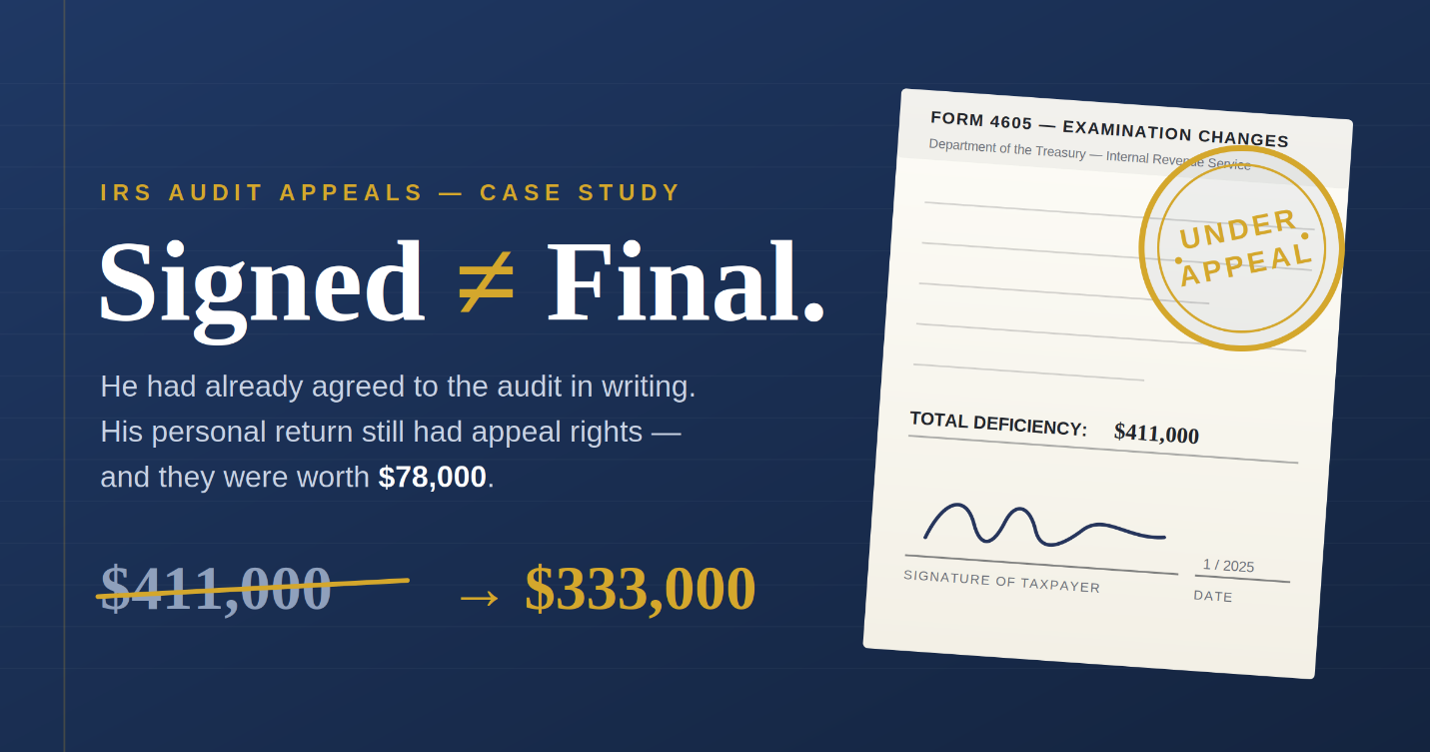
- Signing IRS Form 4605 means you agree to the results of that examination — but it does not automatically waive appeal rights on related returns, including a personal Form 1040 that receives flow-through adjustments.
- In one Rubin CPA case, a client who had signed his S-corporation audit still appealed his personal return and reduced the bill from $411,000 to $333,000.
- Reassigned-audit errors — mistakes introduced when an exam changes Revenue Agents — are increasingly common after the IRS lost roughly 17,000 employees in 2025.
- Appeal windows are short and procedural. Review audit results immediately, even if they’re signed.
He had already signed the paperwork agreeing to the audit. The bill was $411,000. Ten months later, it was $333,000 — and not one dollar of the IRS’s core finding changed.
What changed was everything around it. This is how audit appeals actually work after a signature, why they matter more right now than at any point in decades, and how to know whether your own “finished” audit deserves a second look.
Can you appeal an IRS audit after signing the results?
Sometimes, yes. Signing an audit agreement form such as Form 4605 or Form 4549 binds you to the results of that specific examination — but related returns can retain their own, independent appeal rights. The most common example: a business audit whose adjustments flow through to the owner’s personal Form 1040. According to Rubin CPA, a tax resolution firm whose partner formerly served as an IRS Revenue Officer and Revenue Agent, that exact distinction reduced one client’s liability by $78,000 after the business exam was already signed.
The catch is time. Appeal rights expire on strict procedural deadlines, and the path (protest, Appeals conference, or a Tax Court petition that routes the case back to Appeals) depends on which notices have been issued. The moment to act is the day the results arrive — signed or not.
What does signing Form 4605 actually waive?
Form 4605 documents your agreement to the examination changes for the audited return. It generally ends the fight over that return’s adjustments. What it does not do is erase the separate procedural rights attached to other returns affected by those adjustments. Taxpayers routinely assume one signature closed every door. In our experience, that assumption — not the audit itself — is often the most expensive line item in the case.
What is a reassigned-audit error?
Reassigned-audit errors are mistakes introduced into an IRS examination when the case is transferred between Revenue Agents — misclassified income, undeveloped workpapers, skipped penalty approvals, and overlooked related entities or tax years. The term comes from a pattern Rubin CPA sees consistently in transferred exams: each handoff drops institutional knowledge of the case, and closing agents under time pressure adopt their predecessors’ numbers without re-verifying them.
The client’s audit above passed through three Revenue Agents. One logged just 14 hours on the case. The last inherited it a year in and left the IRS mid-case during the agency’s 2025 workforce reduction of roughly 17,000 employees. Inside that turnover: a passive/non-passive misclassification that froze $235,000 in losses the client was entitled to use.
How does an appeal after signing actually proceed?
In this case: a petition to the U.S. Tax Court in December 2025, which routed the matter to the IRS Independent Office of Appeals. Appeals exists to settle cases based on hazards of litigation — the officer weighs how each issue would fare in court. Strategy matters enormously here. We conceded the exam’s core finding (a $1 million income understatement the IRS got right) and contested only the classification errors. Conceding the strong point made every remaining argument more credible, and the Appeals Officer ultimately adopted our reclassification in full.
What should you look for in signed audit results?
- Agent turnover — ask for, or request under FOIA, the Form 9984 activity record
- Passive vs. non-passive reclassifications (see our companion guide, linking to Blog Post 2)
- Deductions or credits that appeared or vanished without written explanation (QBID is a frequent casualty — audit software does not add it automatically)
- Penalties asserted — or skipped — without documented approval
- Spouses’ activities classified identically without analysis
FAQ
Q: How long do I have to appeal an IRS audit?
A: It depends on the notice. A 30-day letter allows a protest to Appeals; a Notice of Deficiency allows 90 days to petition Tax Court. Both clocks are unforgiving — have results reviewed immediately.
Q: Is audit reconsideration the same as an appeal?
A: No. Reconsideration asks Examination to reopen the audit, typically with new information; an appeal challenges the results through the Independent Office of Appeals or Tax Court. The right path depends on what you signed and which notices were issued.
Q: Do I need representation for an IRS appeal?
A: You may represent yourself, but Appeals is a negotiation over litigation hazards — experience with how the IRS builds and defends exam files materially changes outcomes. Rubin CPA’s team includes a former IRS Revenue Officer and Revenue Agent and a Certified Tax Resolution Specialist.
If you’re holding audit results — signed or unsigned — the review costs a conversation and the window is finite. Request a confidential audit review. Results depend on the facts of each case; past results do not guarantee a similar outcome.
M.A. Rubin CPA, PLLC – RubinOrtolano – A Tax Resolution & Representation Firm
Tel: 833 MA Rubin (627 8246)
Email: Blog@RubinTaxRelief.com
Disclaimer: This blog post is for informational purposes only and does not constitute legal or tax advice. Consult a qualified professional for specific advice regarding your situation.
Disclaimer: This blog post is for informational purposes only and does not constitute legal or tax advice. Consult with a qualified professional for specific advice regarding your business.
