Kwong in Brief (Part 1):
What changed
- A federal court in Kwong v. United States held that the COVID-19 disaster triggered a mandatory deadline suspension under §7508A(d).
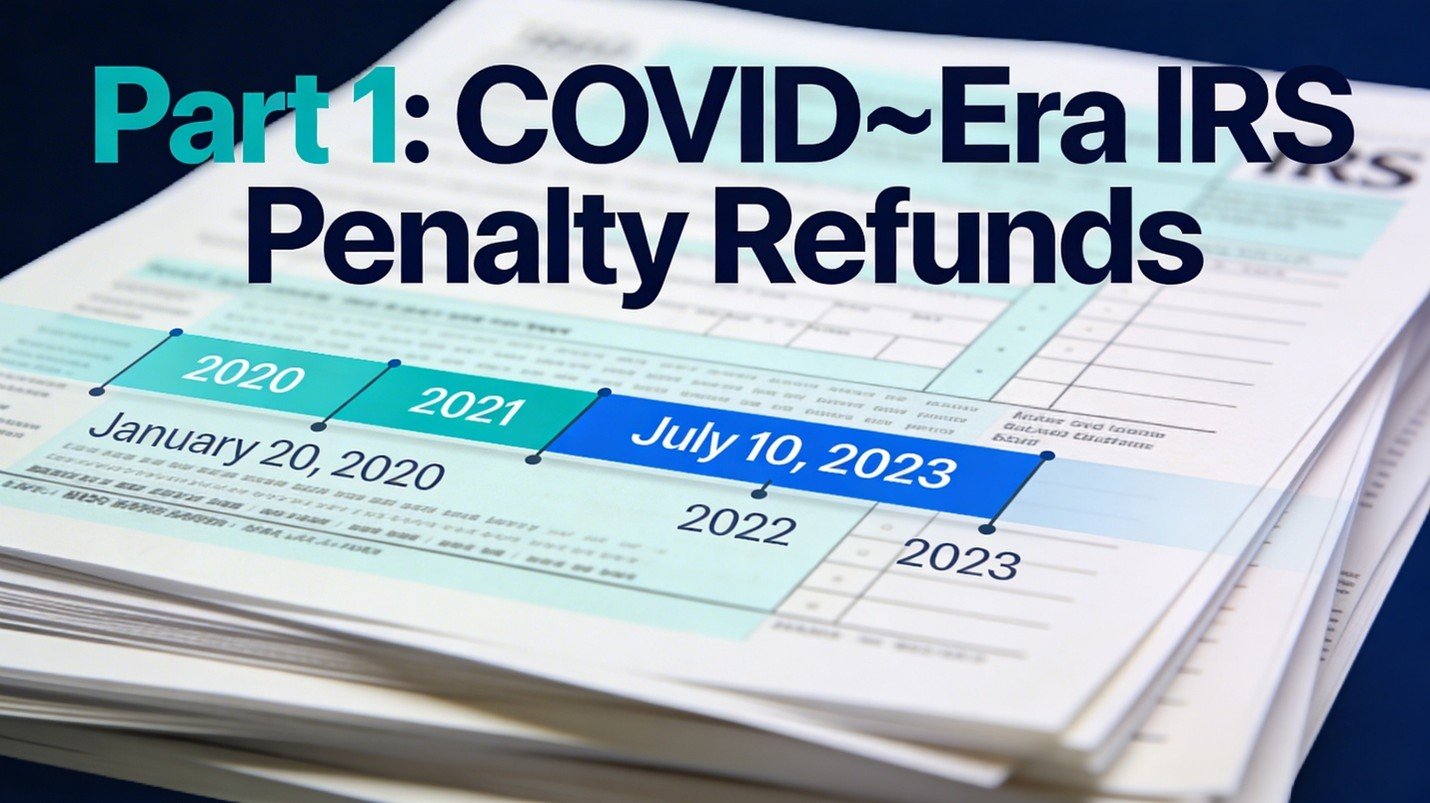
- That suspension runs from Jan. 20, 2020, through July 10, 2023.
- During that period, certain tax deadlines must be disregarded for calculation purposes.
Why it matters
- Penalties (failure‑to‑file, failure‑to‑pay) and underpayment interest often hinge on due dates.
- If a due date falls inside the disaster window, the law says the clock stops—even if the IRS acted like it didn’t.
- Result: some COVID-era penalties and interest may be improper and refundable.
Not just IRS “grace”.
- IRS 2020 notices gave short extensions; Kwong says the statute gave much more.
- Relief is statutory, not discretionary.
- Courts have also pushed back on IRS attempts to narrow disaster relief regulations.
Who should care
- Individuals and businesses with penalties or interest tied to 2019–2022 returns.
- Anyone whose filing or payment deadline landed between Jan. 20, 2020, and July 10, 2023.
- Taxpayers told “you’re too late” for a refund—before anyone mentioned §7508A(d) or Kwong.
Bottom line
Kwong doesn’t magically erase every penalty. But it does reopen the analysis on whether the IRS:
- Used the right due dates
- Charged penalties and interest for time that legally shouldn’t count
- Cut off refund rights too early
If you paid COVID-era penalties and interest, you may have a narrow, time-sensitive shot at getting some of that money back.
If this sounds technical, it is—and that’s exactly why many taxpayers and even professionals are missing it.
Below is the full, detailed Part 1 analysis that:
- Breaks down the COVID-19 disaster period and the key dates
- Explains what the Kwong court actually decided
- Connects the law to real-world penalty and interest calculations
Full Article – Part 1
Kwong v. United States: COVID‑Era IRS Penalties, Interest, and a New Path to Refunds (Part 1)
As 2026 moves into full swing, many taxpayers are still dealing with IRS penalties and interest stemming from the pandemic years. What looked like “normal” enforcement at the time may now be vulnerable to challenge because of a major federal court ruling, Kwong v. United States, decided in late 2025.
Kwong held that the COVID-19 disaster declaration triggered a mandatory suspension of certain federal tax deadlines under §7508A(d), and that the suspension ran from January 20, 2020, through July 10, 2023. That ruling opens the door for taxpayers to seek refunds of penalties and interest the IRS assessed during the pandemic – even where traditional limitation periods appeared to have expired.
The COVID-19 Disaster Period: Why the Dates Matter
When President Donald Trump declared COVID-19 a national emergency under the Stafford Act on March 13, 2020, the emergency was deemed to have begun on January 20, 2020. FEMA later designated May 11, 2023, as the closing date of the COVID-19 incident period.
Under §7508A(d) as it existed when COVID-19 was declared:
- The disaster suspension period begins on the earliest incident date (January 20, 2020).
- It ends 60 days after the disaster incident period closes (July 10, 2023).
Kwong confirms that this entire period – more than three years – must be disregarded when computing certain federal tax deadlines within §7508A’s scope. That includes deadlines for:
- Filing federal income, estate, gift, employment, and excise tax returns
- Paying those taxes
- Filing refund claims
- Bringing suit on refund claims
This is far broader than the limited filing extensions many practitioners remember from the first months of 2020.
What Kwong Actually Decided
In Kwong v. United States, the U.S. Court of Federal Claims addressed whether the COVID-19 disaster suspension applied to the two-year statute of limitations for refund suits under §6532(a). The government argued that:
- The mandatory suspension was much narrower than the taxpayer claimed, and
- A 2021 amendment to §7508A(d) restricted the postponement to 60 days from the start of a disaster, not the entire incident period.
The court rejected those arguments and held that:
- The 2019 version of §7508A(d) governs COVID-19 because the disaster was declared before the 2021 amendment.
- For COVID-19, federal tax deadlines covered by §7508A were postponed for the entire federally declared disaster period plus 60 days, i.e., January 20, 2020, through July 10, 2023.
- That entire period must be excluded when calculating the §6532(a) two-year limitation period for refund suits.
While the case directly addressed refund‑suit deadlines, its reasoning on §7508A(d) also supports disregarding the disaster period when computing other tax deadlines that fall within the statute, including those relevant to penalties, interest, and refund claims.
IRS Notices vs. Statutory Relief
During the early pandemic months, the IRS issued notices such as Notice 2020‑17 and 2020‑18, which postponed certain deadlines for a limited time. Many taxpayers and advisors assumed these notices set the full boundaries of COVID‑era relief.
Kwong makes clear that the statute is doing much of the real work:
- The court emphasized that §7508A(d) provides a mandatory postponement of covered deadlines, independent of IRS discretion.
- IRS guidance and regulations that conflict with the statute are not controlling.
This approach is consistent with Abdo v. Commissioner (162 T.C. No. 7 (2024)), where the Tax Court invalidated portions of Treas. Reg. §301.7508A‑1(g) and held that §7508A relief operates automatically. Together, Abdo and Kwong significantly broaden the recognized scope of COVID-era disaster relief.
How This Connects to Penalties and Interest
Underpayment interest and many civil penalties – including failure‑to‑file and failure‑to‑pay – are computed with reference to statutory due dates and periods of noncompliance. If §7508A(d) requires that the disaster period be disregarded, several consequences follow:
- Payment deadlines for covered taxes that “fell” inside the pandemic disaster window effectively shift forward, often to at least July 10, 2023.
- If a due date is postponed by statute, charging penalties and interest as if there was no postponement may be improper.
- In some cases, taxpayers who paid underpayment interest and penalties between 2020 and 2023 now have a basis to seek refunds or abatements.
Advisories from multiple national firms now highlight potential refund opportunities for penalty and interest amounts that accrued during the COVID-19 disaster period, particularly where payment deadlines fell within the suspended window.
A Simple Corporate Example
Consider a calendar‑year C‑corporation:
- 2020 federal income tax balance due: April 15, 2021
- Balance actually paid: August 1, 2022
- IRS assessed failure‑to‑pay penalties and underpayment interest from April 15, 2021, through August 1, 2022.
Under the Kwong interpretation:
- The April 15, 2021, payment due date falls squarely inside the January 20, 2020–July 10, 2023, disaster suspension period.
- If that entire period must be disregarded for covered deadlines, the statutory basis for penalties and interest computed as though April 15, 2021, was an uncompromised due date becomes questionable.
That could justify filing a refund claim for some or all of the penalties and interest assessed during that “suspended” period, subject to a detailed factual and legal review.
What’s Coming in Part 2
In Part 2, we will dig into:
- How §7508A(d) interacts with the refund‑claim rules in §6511
- When the disaster suspension can make a “late” claim timely
- Practical steps for building a Kwong-based refund claim for penalties and interest
If you suspect you paid COVID-era penalties or interest on obligations that came due between January 20, 2020, and July 10, 2023, this next part will be especially important.
How a Tax Resolution–Focused Firm Helps with Kwong Claims
Trying to navigate Kwong, §7508A(d), and IRS procedures alone can lead to missed opportunities and expired rights. A CPA firm that focuses on tax resolution can bring structure, documentation, and experience to this evolving area.
That often includes:
- Diagnostic review and transcript analysis to see exactly what the IRS sees: balances by year, assessment dates, and how penalties and interest were applied during the COVID‑19 disaster window.
- A written resolution roadmap that sequences any catch-up filings, quantifies potential Kwong-based refunds, and identifies refund‑claim deadlines after applying the disaster suspension rules.
- Professional representation before the IRS so taxpayers aren’t left arguing complex statutory issues on their own or missing key procedural steps.
For a firm like M.A. Rubin CPA, PLLC – Stop IRS Tax Problems, the goal is simple: turn COVID-era penalties, interest, and confusing IRS notices into a clear, defendable resolution and refund strategy that supports long-term compliance and peace of mind.
Act Now
Starting 2026 with unresolved IRS penalties and interest from the pandemic years does not have to define the rest of the year. Kwong and related rulings have created a time-sensitive opportunity to revisit those balances and, in many cases, to seek refunds or abatements before extended deadlines expire.
If there are COVID-era penalties, growing interest, or prior refund denials that never considered §7508A(d), now is the moment to move from worry to action and build a resolution plan with professional guidance and a documented strategy.
Schedule an Appointment Below!
M.A. Rubin CPA, PLLC
Tel: 833-MA-Rubin (627-8246)
Email: Blog@RubinTaxRelief.com
Disclaimer: This blog post is for informational purposes only and does not constitute legal or tax advice. Consult with a qualified professional for specific advice regarding your business.
