Recent Articles
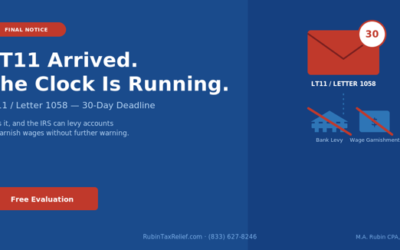
Missed Your LT11 Deadline? What Happens After the IRS’s Final Notice in 2026
Quick Answer: An LT11 or Letter 1058 is the IRS's Final Notice of Intent to Levy. It gives you 30 days to file Form 12153 for a Collection Due Process hearing before the IRS can levy bank accounts or garnish wages. Miss that window, and Commissioner v. Zuch (2025)...

IRS Automated Collection Notices Are Back in 2026 — What CP14, CP501, CP503, and CP504 Really Mean
Quick Answer: In 2026 the IRS resumed automated collection notices at full speed, sending CP14, CP501, CP503, and CP504 letters on a fixed schedule again. Each notice narrows your options and shortens your response window. By the time a CP504 arrives, your state tax...
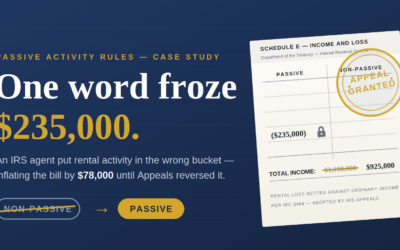
Passive vs. Non-Passive Income: The IRS Audit Error That Can Freeze Six Figures in Losses
By M. Rubin, CPA — M.A. Rubin CPA PLLC / RubinOrtolano | Published: July 19, 2026 | Reviewed by: D. Ortolano Jr. EA, former IRS Revenue Officer & Revenue Agent RubinOrtolano Passive activity losses generally offset only passive income; misclassifying an...
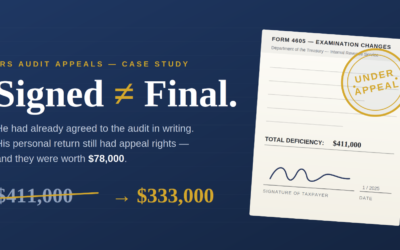
Can You Appeal an IRS Audit After You’ve Already Signed?
By M. Rubin, CPA — M.A. Rubin CPA PLLC / RubinOrtolano | Published: July 5, 2026 | Reviewed by: D. Ortolano Jr. EA, former IRS Revenue Officer & Revenue Agent RubinOrtolano Signing IRS Form 4605 means you agree to the results of that examination — but it does...

IRS Bank Levy: How to Get Your Money Back
Quick Answer: An IRS bank levy freezes your entire account balance on the day the levy is served. Your bank holds those funds for 21 days before sending them to the IRS — giving you a narrow window to act. If you already had a wage garnishment or IRS lien filed...
How to Stop IRS Wage Garnishment
Quick Answer: The IRS can garnish your wages without a court order after sending a Final Notice of Intent to Levy (Letter 1058 or LT11). To stop it, you must request a Collection Due Process (CDP) hearing, enter a payment agreement, or qualify for Currently Not...